

There's a particular kind of insult that does not say you are wrong, exactly. It says you are not really there.
'NPC' is one of those. In its original, useful sense, an NPC is a non-player character: the shopkeeper who says the same line every time you click on him, the quest-giver with an exclamation mark over her head, the guard who tells you that somebody stole his sweetroll. Oxford defines an NPC as 'a video game character that is not controlled by a player of the game', and gives the abbreviation as non-player character. Merriam-Webster similarly defines it as a character in a game that does not represent and cannot be manipulated by a player, and dates the first known use to 1977.
That definition matters because the insult depends on it. To call someone an NPC is not merely to call them boring. It's to suggest they are scripted, reactive – empty of interior life. They do not argue, they output dialogue. They do not believe, they repeat. They are not a person with a mind; they are scenery with a mouth.
There's a small terminology trap to point out at this stage. The correct expansion is non-player character, not non-playable character. The second phrase is common, and you will definitely see it in the wild, but it is not quite the same thing. In game design terms, 'playable' is about whether a character can be selected or controlled as a playable role. 'Player' is about whether the character is currently controlled by a player. An NPC may be unplayable in a particular game, but the point of NPC is not that the character could never be playable under any circumstances. It is that the character is not a player character. The dictionaries are on the 'player' side, even if casual use often drifts towards 'playable'.
Referring to other people as robotic, automated, or incapable of independent thought by comparing them to video game characters is not a new phenomenon, though, and has probably been around as long as video games have. The specific use of NPC as an insult predates its later spread; for example one Urban Dictionary entry from 2008 defines NPCs as "unimportant people" who "may occasionally provide useful information, but they tend to repeat it over". A later 2010 Urban Dictionary entry uses 'NPC' to belittle employees who respond to questions with "rote, scripted dialogue". This comment in the LessWrong community from 2011 uses NPC in the pejorative sense. A 2009 reply on the 'Giant in the Playground' forum lists "You're just an NPC!" as an example of 'insults for nerds'. Nevertheless, 'NPC' as an insult remained a relatively obscure phenomenon.
The insult version grew primarily out of imageboard culture, then entered mainstream political slang with unusual speed. A 2023 paper in Big Data & Society traces a key early use to a July 2016 post on /v/, 4chan's videogames board, where the poster compared supposedly unthinking people to videogame NPCs. By 2018, according to the same paper, the term had become common in right-wing subcultural spaces as a way of describing people, especially liberals and leftists, as incapable of thinking for themselves. Kotaku, itself a left-wing outlet, described the NPC meme as an attempt to dehumanise SJWs ('Social Justice Warriors').
The meme's most recognisable form was the grey NPC Wojak face: expressionless, blank-eyed, and designed to look as if it had been assembled from minimum viable personhood. It was simple enough to be remixed into countless variants. That was part of the appeal. The NPC face could be given coloured hair, activist slogans, corporate vocabulary, pandemic-era catchphrases, or whatever else the poster wanted to portray as a preloaded script.
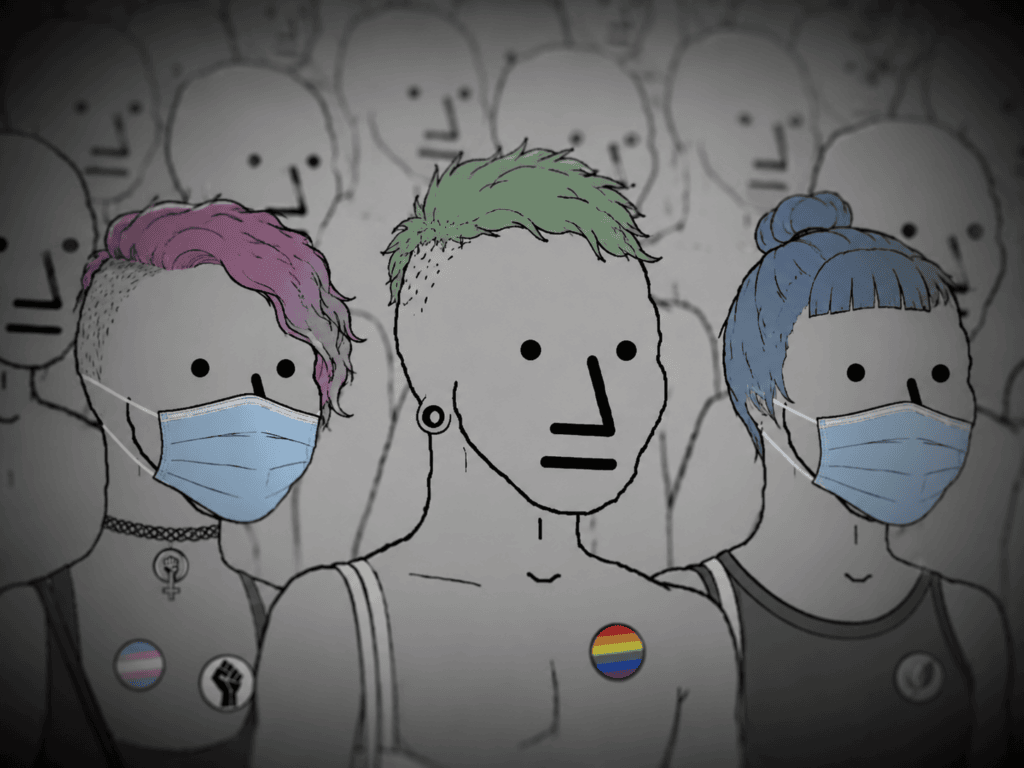
In October 2018, the term broke containment. Twitter (now X) banned more than 1,500 spoof accounts using NPC-style avatars, after some were used to pose as liberal activists and tweet misleading election-related messages. The New York Times and The Verge both covered the episode, with The Verge noting the uncomfortable media dynamic: explaining the meme also helped spread it.
That dynamic is still the problem with writing about it. 'NPC' is an insult that wants attention but also feeds on being denounced. Call it dehumanising, and its users can reply that you are proving the joke by following the expected script. Ignore it, and it keeps circulating anyway. It's a neat little troll device because it treats disagreement as confirmation. If you object, you are an NPC. If you do not object, you are background noise.
Part of the reason the insult travelled so well is that it mapped a real irritation onto a bad explanation. Online life does often feel repetitive. People do quote the same slogans, make the same jokes, chase the same formats, and perform the same micro-identities. Social platforms reward legible behaviour. Algorithms like patterns. Political tribes like catchphrases. Workplaces like approved language. Even dating apps and LinkedIn posts can start to feel as if everyone is drawing from a shared folder of dialogue options.
The NPC insult takes that recognisable flattening and turns it outward. The problem is never that platforms script us, or that incentives shape behaviour, or that all of us sometimes borrow our opinions from the ambient feed. The problem is them. They are the automated ones. They are the quest-givers. They are the ones whose minds are missing.
That asymmetry is what makes the insult nastier than it first appears. Calling someone an idiot attacks their judgement. Calling someone an NPC attacks their personhood. It says there is no point persuading them because there is nobody inside to persuade. In political contexts, that falls short of being just mockery; it's permission to stop listening. That's what makes the insult more barbed than it first appears. It gestures, crudely, towards an old philosophical anxiety: how do you know there is anyone home behind another person's face? In a recent philosophy paper (PDF), Netanel Ron uses 'real world NPCs' as a thought experiment for beings that look and behave like normal creatures but lack phenomenal consciousness. The meme version is not doing philosophy with any care, but it is borrowing the same shape of thought. Calling someone an NPC does not just say their opinions are bad. It hints that there may be no inner life behind them at all.
The term has since loosened from its original partisan setting. Teenagers use it to mean someone dull, predictable, or socially generic. Gaming language has spilled so thoroughly into everyday speech that a Guardian glossary in 2026 described NPC as increasingly used for people seen as robotic or lacking interiority. The TikTok era also complicated the term with 'NPC streaming', where performers deliberately act like repetitive game characters in response to paid prompts from viewers. That's not the same as the insult, but it shows how easily the image of the scripted human can move between mockery, performance, and monetisation.
There is a generous reading of 'NPC' as a protest against conformity. In that version, it means: stop outsourcing your thoughts, stop parroting the approved line, stop letting the machine speak through you. Used self-critically, it can even be funny. Everyone has NPC moments. Everyone has a default line they say when someone asks how work is going. Everyone has a bit of pathfinding code that fails around a kitchen island.
But as an insult, NPC rarely lands that way. It's usually not an invitation to think more deeply. It's a way of declaring that the speaker already has. It flatters the person using it as the rare conscious actor in a world of loops and scripts. That is why the insult has such durable appeal. It offers the cheapest possible form of enlightenment: everyone else is programmed, and you alone have found the debug menu.
The irony, of course, is that 'NPC' itself has become one of those repeatable lines. It is a stock response, a canned animation, a button you press when someone annoys you online. The person typing it may feel like the protagonist, but the dialogue box is already written.
Note: this article was last updated in July 2026.

